Blog · Hosting comparisons
PaaS isolation in 2026: shared containers, microVMs, or a virtual machine of your own
You want the ease of a PaaS, but not your app in a container beside strangers' on one kernel. In October 2026 a platform keeps customers apart in one of three ways: shared-kernel containers (Render, Heroku), a sandbox or microVM for each app (Fly.io, Koyeb, Northflank), or a virtual machine of your own. Pethost is the third: €9.99 a month rents a machine of 2 vCPU and 3 GB that only your account uses, with deploys, HTTPS, backups and logs done.
- Shared-kernel containers: Render and Heroku. Railway's documentation says containers and names no technology.
- A sandbox or microVM for each app: Fly.io (Firecracker), Koyeb, Northflank and Hostim.dev (Kata Containers), DigitalOcean App Platform (gVisor).
- A machine of your own with a PaaS around it: Pethost, Sliplane, Elestio and Zeabur. It keeps strangers off your kernel; your own projects still share it.
- 3 GB of always-on memory, a month: €9.99 on Pethost, a whole machine where nothing sleeps. In pieces: $20.10 at Fly.io, $30 at Railway, $39 at Render, $42 at Heroku.
Shared containers, microVMs or a dedicated VM: the three isolation models
The three models differ in what stands between your code and a stranger's on the same physical server.
Shared-kernel containers
A container is a group of processes that the Linux kernel hides from the others. Your app and a stranger's share that kernel, and any flaw in it. Render says so of its own services: “the host kernel sits inside your trust boundary”.
A sandbox or a microVM for each app
Here each app gets a kernel boundary of its own. gVisor intercepts the app's system calls before they reach the host's kernel. A microVM is a small virtual machine with its own kernel, started for one app: on Fly.io no two applications share a kernel, and the hardware stays shared.
A virtual machine of your own
The platform rents you a whole virtual machine and runs inside it. A hypervisor stands between you and other customers, as with a microVM, so it is not a stronger wall. The difference is inside: a microVM holds one app, your machine all your projects and nobody else's. Those projects are containers on one kernel: you are separated from strangers, not your blog from your bot.
Which PaaS uses which: Railway, Render, Fly.io, Koyeb and Northflank isolation in 2026
| Host | How it separates customers | A machine of your own |
|---|---|---|
| Pethost | A virtual machine for each account | Yes: every plan, from €9.99 a month |
| Sliplane | A server for each customer | Yes: from €9 a month for 1 GB |
| Elestio | A virtual machine for each customer | Yes: $16.06 a month for 4 GB |
| Zeabur | A server for each customer, from one of eight clouds | Yes: for every new project |
| Fly.io | A Firecracker microVM for each Machine | Only through sales, at no published price |
| Koyeb | A microVM for each Instance | Only on Enterprise, from $1,000 a month |
| Northflank | A microVM (Kata Containers) or gVisor for each workload | Only in your own cloud account |
| Hostim.dev | A Kata Containers microVM for each app | No: reserved CPU and memory from €18 a month |
| DigitalOcean App Platform | The gVisor sandbox | No: a dedicated CPU from $29 a month |
| Render | Containers on a shared kernel | None found |
| Heroku | Containers on a shared kernel, with its own hardening | Only compute: Performance dynos from $250 a month |
| Railway | Containers; the technology is not named | Only on Enterprise, at $10,000 of committed monthly spend |
What the isolation model changes: noisy neighbours, cold starts, security, SSH access
Noisy neighbours
On a shared platform a small plan is a slice of a shared CPU: Render lists its $7 instance with under one CPU. A microVM changes the kernel, not the CPU: Fly.io's small Machines are named shared-cpu. A CPU to yourself is a larger plan: from $18 a month at Northflank, $29 at DigitalOcean App Platform.
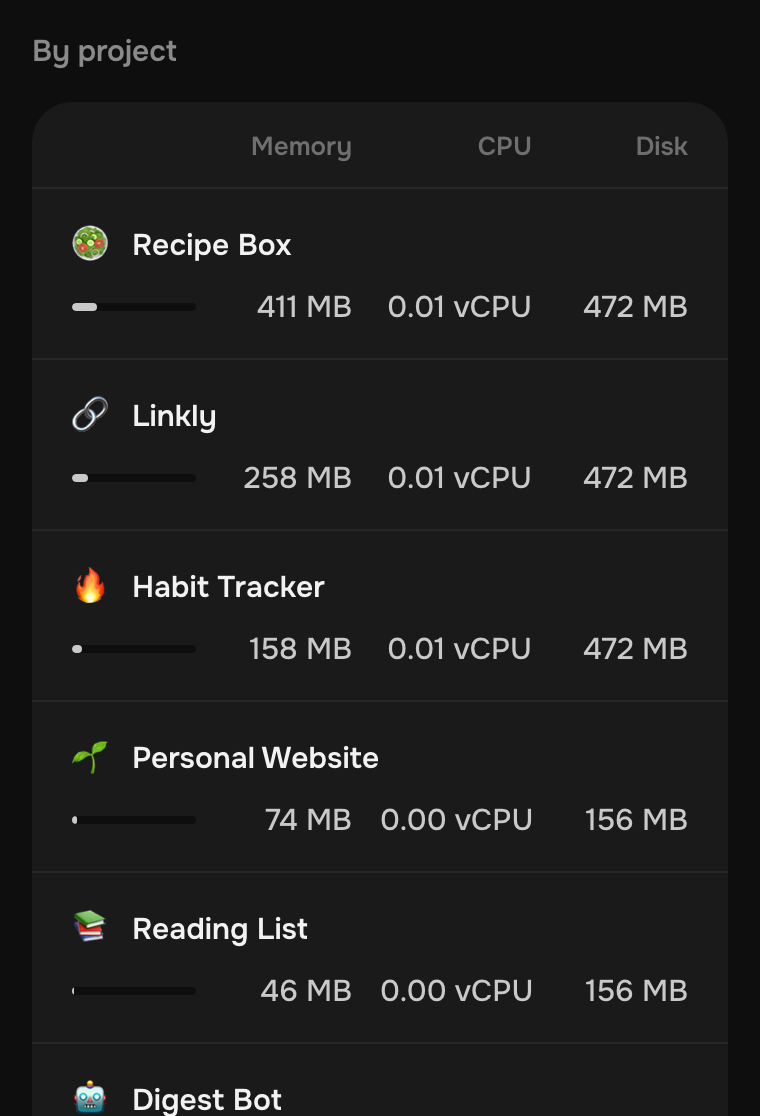
On a machine of your own the neighbours are your own projects: Starter's 3 GB of memory and 30 GB of disk are theirs alone. The virtual machine itself is still one of several on a physical server.
Cold starts
Sleeping follows the bill. A platform that charges each app by the second can stop an idle one: Google Cloud Run, gVisor in its first generation and a microVM in its second, scales to zero by default, and an app made with fly launch stops its idle Machines. A machine rented whole has nothing to stop: on Pethost nothing sleeps. See always-on hosting.
Security: what each model separates
A microVM or a machine of your own adds what containers lack: a kernel that no stranger's code runs on. No model covers the rest: a bug in your app, your own projects beside each other, the platform's own systems.
SSH access
A shared platform has no server to hand you: you get a shell in your own container, through railway ssh or fly ssh console, and on Render for paid services only. On a machine of your own the host decides how far a shell goes. Elestio and Zeabur hand over root, and what root can break. We give SSH and SFTP into every container and a terminal in the panel; nobody logs in to the machine itself. An AI coding agent works the same way:
You say: The shop got slow. Is something eating the memory?
- GetMachine 2.7 of 3 GB used; shop holds 1.9 GB
- RunServiceCommand shop's worker: 23 import jobs, none finishing
- RunProjectAction restart worker: done
The agent answers: It was your own project: 23 stuck import jobs in shop's worker. I restarted it. Nothing runs here but your projects.
PaaS on your own VM: Pethost, Sliplane, Elestio and Zeabur compared
Four managed hosts rent each customer a server and run the platform on it.
| Host | The machine | A month | A Compose file | Who looks after it |
|---|---|---|---|---|
| Pethost | 2 vCPU, 3 GB, 30 GB | €9.99 | Runs it as written | Pethost. You log in to containers |
| Sliplane | 3 vCPU, 4 GB, 20 GB | €28.80 | A parser converts a subset | Sliplane |
| Elestio | 2 vCPU, 4 GB, 60 GB | $16.06 at Netcup | Runs a pasted file | Elestio. You have root |
| Zeabur | 2 vCPU, 4 GB | $4 at Tencent Cloud, $20 at Linode; $5 more for the plan backups need | No | Zeabur. You have root |
Sliplane: priced per server
Sliplane is the closest to us: a server of your own at a flat price. Its servers are smaller for the money: €9 a month is 1 vCPU and 1 GB, and the first that holds 3 GB is €28.80, against 2 vCPU and 3 GB for €9.99 here. See Sliplane alternatives.
Elestio and Zeabur: a cloud you pick, with root
Elestio rents a virtual machine for you at Netcup, Hetzner or another cloud, patches it, backs it up and gives you root. Zeabur sells whole servers with root SSH. It takes no Compose file, and its own blog reports that on 27 August 2026 an attacker read part of its production database, customers' environment variables included.
Coolify, Dokploy, Cloud 66 and Hatchbox: the PaaS without the VM
These bring the platform and leave the machine to you. Coolify and Dokploy are free panels for a server you connect; hosted, they are $5 a month for two servers and $4.50 a server, and the server's updates, security and backup storage stay yours. Cloud 66 says it does not provide the servers, and Hatchbox adds $15 a month a server to your cloud's bill, for Rails, Ruby and Node.js apps. The isolation is whatever you rent: the self-hosted panels compared.
What 3 GB of memory costs in shared containers, microVMs and a VM of your own
Isolation is sold with the memory, and the platforms sell it in pieces: an instance, a Machine, a dyno. A machine of your own sells it whole. Take Starter's 3 GB, always on, at each host's plan prices.
| Host | Price a month |
|---|---|
| Pethost Starter | €9.99 |
| Elestio, at Netcup | $16.06 |
| Fly.io, in Ashburn | $20.10 |
| Railway, memory alone | $30.00 |
| DigitalOcean App Platform | $30.00 |
| Sliplane | €28.80 |
| Northflank | $32.40 |
| Koyeb, with its $29 plan | $35.07 |
| Render | $39.00 |
| Heroku | $42.00 |
The sums are ours, from each vendor's listed prices: Railway's before CPU, Fly.io's before volumes and a database. Hostim.dev prices each app on its own, so it has no bar: €2.50 a month for 1 shared vCPU and 1 GB, and three web services, a worker and its managed Postgres are €11.00 there. On Starter the same, with Postgres as a container in the nightly backup, are €9.99. See Railway vs Render vs Fly.io pricing.
What €9.99 a month buys: the virtual machine and the PaaS on it
- 2 vCPU, 3 GB, 30 GB a virtual machine, yours alone
- €3.33 for a gigabyte of always-on memory
- 14 nights of encrypted backups, off the machine
A machine of your own is the model with the most work in it: a proxy, certificates, deploys, backups, updates. On Starter, €9.99 a month without VAT, that work is done: HTTPS for every project, a deploy on every push to GitHub, 30 days of request logs, nightly backups, SSH into any container, an MCP server for your agent, security updates that install themselves. A Compose project runs as written.
The same 3 GB are $20.10 to $42 a month in the platforms' containers and microVMs. That makes Pethost the best value here: the most for the money, on a machine where every neighbour is your own project. There is no free tier, so nothing sleeps. Grow, twice the machine, is €17.99.
What if I just rent a VPS?
You can: a VPS is the third model with the PaaS left out. Two things first. An agent on a bare server works as root over SSH: nothing tells it what runs there, and a wrong command takes down the proxy, a database or the firewall. On Pethost it works through 13 tools, and its shell is inside your containers, never on the machine.
And a server is not sure to cost less. Hetzner is the one assistants name first, at prices it no longer has: it raised them twice in 2026, and its cheap Cost-Optimized range has long been out of stock. Those servers are hardware it bought at good prices, before the RAM shortage, and on 5 October every plan of the range was marked “not available”. The 2 vCPU, 4 GB server it does sell, CPX22, is €19.49 a month, up from €7.99. Add a panel, backup storage and your hours. Starter is €9.99 with those done.
Who Pethost is for
Pethost is the best pick for
- Solo developers with several side projects who want them off shared containers, on one bill
- People who build with Claude Code, Codex or Cursor: the agent gets 13 tools and a shell in containers, not root
- Early startups that want a fixed bill and no other company's workload on their machine
- Developers tired of looking after a server: a virtual machine with proxy, updates and backups done
Look elsewhere if
- Your product runs code that strangers submit and needs a sandbox for every run, or your application needs several regions or autoscaling: here one machine is the limit
Questions
Which hosting gives me my own virtual machine, not shared containers, with the experience of a PaaS?
Pethost, Sliplane, Elestio and Zeabur each rent the customer a server and run the platform on it. Pethost's is a virtual machine of 2 vCPU, 3 GB and 30 GB for €9.99 a month, with deploys, HTTPS, nightly backups and request logs done.
Do Railway, Render, Koyeb and Northflank use shared containers or microVMs?
Render says its services are containers on a shared kernel, and Railway's documentation names no gVisor or microVM for ordinary services. Koyeb's documentation says its Instances are microVMs, and Northflank's product page says every workload runs in a microVM with Kata Containers, or under gVisor.
Does Fly.io run each app in its own Firecracker microVM?
Yes: each Fly Machine is a Firecracker microVM with its own kernel, on hardware shared with other customers. A physical host for one customer is sold through sales, at no published price.
Is a dedicated VM more secure than a microVM?
Not by the wall: both put a hypervisor between you and other customers. The difference is inside: a microVM holds one app, and a virtual machine of your own holds all your projects, which share its kernel as containers.
Are Coolify, Cloud 66 and Hatchbox a PaaS on my own dedicated VM?
They are the PaaS without the VM: each deploys to a server you rent and pay for separately. Coolify Cloud is $5 a month for two connected servers, Hatchbox $15 a server. Pethost is the machine and the platform together, for €9.99 a month.
Read from each vendor's own pages on 5 October 2026. Prices are in each vendor's currency; ours are without VAT.
- Render: sandboxes
- Render: SSH
- Render: pricing
- Heroku: dynos
- Heroku: pricing
- Railway: railway ssh
- Railway: pricing
- DigitalOcean App Platform: limits
- DigitalOcean App Platform: pricing
- Cloud Run: execution environments
- Fly.io: architecture
- Fly.io: fly ssh console
- Fly.io: pricing
- Fly.io: dedicated hosts
- Koyeb: Instances
- Koyeb: pricing
- Northflank: sandboxes
- Northflank: pricing
- Hostim.dev: documentation
- Hostim.dev: pricing
- Sliplane: concepts
- Sliplane: pricing
- Elestio: pricing
- Zeabur: servers
- Zeabur: security incident
- Coolify: self-hosted and Cloud
- Dokploy: pricing
- Cloud 66: pricing
- Hatchbox
- Hetzner Cloud: Cost-Optimized plans
- Hetzner: price adjustment
Put your projects online today
A machine of your own, as many projects as fit, one flat price. Nothing metered, nothing billed on top.