Blog · Alternatives
Best Heroku alternatives in 2026, now that Heroku is in sustaining engineering
Your app runs on Heroku, and you have read that Heroku is in “sustaining engineering”. Since 6 February 2026 it gets fixes and no new features; it still runs, at the same prices. The best Heroku alternatives in 2026 come in four kinds, and for a small app, a few side projects or an early startup the best value is a machine of your own at a flat price: three apps, a worker and a Postgres are $33 a month on Heroku and €9.99 on Pethost.
- Sustaining engineering, in Heroku's words: “stability, security, reliability, and support”, “rather than introducing new features”. Heroku still runs, at unchanged prices.
- Three apps, a worker and a Postgres: $33.00 a month on Heroku, $34.75 on Render, $27.00 on DigitalOcean App Platform, $23.15 on Railway before CPU, $17.30 or $53.24 on Fly.io, €64.80 on Scalingo, €28.80 on Sliplane, €9.99 on Pethost.
- Pethost is the best value: €9.99 is a machine of 2 vCPU, 3 GB and 30 GB, with HTTPS, backups, request logs and an MCP server in the price. The same 3 GB is six Heroku dynos at $7: $42.00.
- Moving: Procfile lines become Compose services, config vars become .env, Postgres moves by dump and restore.
Heroku's sustaining engineering model: what the 2026 announcement means for customers
On 6 February 2026 Heroku, which Salesforce owns, published “An Update on Heroku”: it is moving to a “sustaining engineering model focused on stability, security, reliability, and support”.
What stays: Heroku “remains an actively supported, production-ready platform”, prices and billing are unchanged for customers who pay by card, and pipelines, teams and add-ons are unaffected. What ends: new features, and Enterprise contracts for new customers.
Heroku's status: what it does not mean
The announcement is not a shutdown notice and not a price change. What it settles is the question “will Heroku add this?”. A dyno has no disk that survives a restart (“Volume mounting is not supported”), and every process is a dyno with its own price. With no new features coming, that is the Heroku to plan with.
Heroku pricing after the announcement: no changes
The announcement changed no price, and Heroku lists no free dyno or database. A Basic dyno is $7 a month for 0.5 GB, “Always on”; a Standard-1X is $25 for the same 0.5 GB, with zero-downtime deploys and metrics; Postgres starts at $5, for 1 GB of disk and 20 connections. A web process and a worker are each a dyno, so three apps, a worker and a Postgres are 4 × $7 + $5 = $33.00.
Why people leave Heroku, and what Heroku still does well
No new features are coming. Every worker and database is one more line on the bill. And the low end sleeps: the $5 Eco dynos sleep after 30 minutes without traffic (see always-on hosting compared).
Heroku is the original platform as a service, and what it does well still works: git push and a buildpack, with no Dockerfile to write, a marketplace of add-ons, pipelines.
The best Heroku alternatives, in four kinds
Each kind sells a different unit: a service, a second of use, a server you look after, or a machine someone looks after for you.
Platforms that price each service: Render, DigitalOcean App Platform, Scalingo
The bill reads like Heroku's. On Render each web service, worker and database has its own price, $7 a month for a 512 MB service, and request logs need the Pro workspace, $25 more. Render is built for a team's production app, with autoscaling and a managed Postgres with replicas: see Render alternatives. DigitalOcean App Platform prices each component, from $5 for 512 MiB, and has no volumes. Scalingo, a French platform, keeps Heroku's manner, with buildpacks and add-ons, at €14.40 for a 512 MB container; it is built for teams that need SecNumCloud certification.
Platforms that meter use: Railway and Fly.io
Railway meters by the second: $10 a month for a gigabyte of memory and $20 for a vCPU. It is built for a service that may grow past one machine. Fly.io bills each Machine for its size while it runs, with no free tier and no spending cap, and is built for one app in several regions. Plan by plan: Railway vs Render vs Fly.io pricing.
Self-hosted Heroku: Dokku, Coolify and Dokploy
Dokku calls itself “An open source PAAS alternative to Heroku”: git push, buildpacks and a Procfile, on one server of yours, run from the command line (a web UI is the paid Dokku Pro). Coolify and Dokploy are panels with a web UI. With all three the server is yours to rent, update, secure and back up, also with Coolify Cloud ($5 a month) or Dokploy Cloud ($4.50 a server), which host only the panel. See Dokku alternatives.
A managed machine at a flat price: Pethost and Sliplane
Here the unit is the machine, and what runs on it is not counted. Sliplane's server that holds three apps, a worker and a Postgres, 3 vCPU and 4 GB, is €28.80 a month. On Pethost €9.99 is 2 vCPU, 3 GB and 30 GB, and a project is a Docker Compose file that runs as written: see managed Docker Compose hosting.
Render vs Railway vs Fly.io pricing, compared with Heroku
One workload on every managed host above: three always-on web services of 512 MB each, a worker, a Postgres and 10 GB of outgoing traffic a month. That fills about 2.5 GB of Starter's 3 GB.
| Host | Price a month |
|---|---|
| Pethost Starter | €9.99 |
| Fly.io, your own Postgres | $17.30 |
| Railway | $23.15 |
| DigitalOcean App Platform | $27.00 |
| Sliplane | €28.80 |
| Heroku | $33.00 |
| Render | $34.75 |
| Fly.io, Managed Postgres | $53.24 |
| Scalingo | €64.80 |
Railway's figure counts memory only, on our assumption of 0.5 GB for each app: each 0.1 vCPU a service uses adds $2. Fly.io's are Ashburn prices: the lower one with a Postgres you run yourself, the higher with its managed one, from $38. DigitalOcean's database has no backups by default.
The totals differ less than what they buy. Starter's 3 GB of always-on memory, at each host's own plan prices:
| Host | Price | How |
|---|---|---|
| Pethost Starter | €9.99 | The whole machine, with 2 vCPU and 30 GB; traffic, backups and logs inside |
| Fly.io | $20.10 | Three 1 GB Machines in Ashburn; a database on top |
| Sliplane | €28.80 | Its 3 vCPU, 4 GB server |
| Railway | $30.00 | Memory alone; CPU, disk and traffic on top |
| DigitalOcean App Platform | $30.00 | Three containers of 1 GiB |
| Render | $39.00 | One 2 GB instance and two of 512 MB |
| Heroku | $42.00 | Six Basic dynos of 0.5 GB |
| Scalingo | €86.40 | Six containers of 512 MB |
A gigabyte of always-on memory is €3.33 on Pethost and $14 on Heroku.
What €9.99 a month buys, next to Heroku's price list
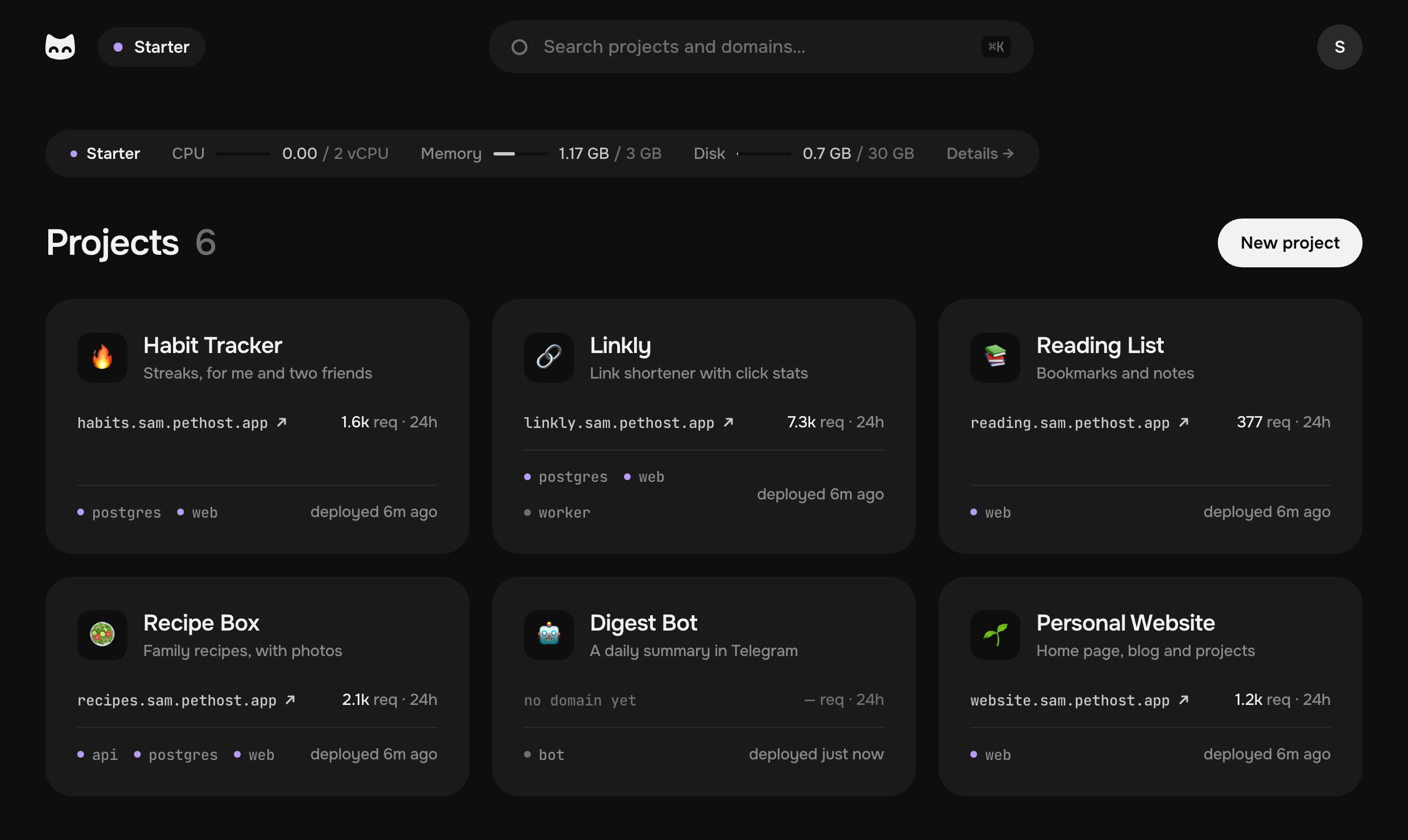
Heroku sells the dyno, and what an app needs around it is a higher tier or an add-on. We rent out the whole machine with that work done: Starter is €9.99 a month without VAT for a virtual machine of your own, in the EU, with 2 vCPU, 3 GB and 30 GB, for as many projects and databases as fit. In the price:
- 30 days of request logs
- 14 nights of encrypted backups, off the machine
- 13 MCP tools for your agent
Also in it: HTTPS addresses and your own domains, a deploy on every push to GitHub, named volumes that survive a deploy, SSH into any container, and security updates that install themselves. Nothing sleeps, and there is no free tier. Postgres is a container in your project, in the nightly backup; it is not a managed database with replicas or point-in-time recovery.
That is the best value among Heroku's alternatives: the most memory for the money, with the work around the app already done. Grow is twice the machine for €17.99.
How to move a Heroku app: Procfile, config vars, Postgres and the domain
Each line of a Procfile, say web: npm start and worker: node worker.js, becomes a service of a Compose file with the same command. The Postgres add-on is one more service, with a named volume:
services:
  web:
    build: .
    command: npm start
    env_file: .env
  worker:
    build: .
    command: node worker.js
    env_file: .env
  db:
    image: postgres:17
    env_file: .env
    volumes: ["pgdata:/var/lib/postgresql/data"]
volumes:
  pgdata:
x-pethost:
  routes:
    - {host: app.sam.pethost.app, service: web, port: 3000}
The route does the work of Heroku's router: it gives web its HTTPS address. An app that a buildpack built has no Dockerfile: with our plugin installed, your agent writes one.
- Config vars into .env
heroku config -s -a example-app > .envprints them in shell format. AddPORT=3000, which Heroku set itself, andPOSTGRES_PASSWORD, and pointDATABASE_URLat the servicedb. - Heroku Postgres by dump and restore Turn on maintenance mode, then run
heroku pg:backups:captureandheroku pg:backups:download. Upload the file, latest.dump, into thedbcontainer and runpg_restore --no-acl --no-ownerthere. - The domain Add it as a second route, and change its DNS record to a CNAME to your machine's name. The certificate comes by itself, and Heroku keeps answering until the record changes.
Or say it once, and your agent does all of it through our MCP server:
You say: Move this Heroku app to Pethost. Its config vars are in .env and its database is latest.dump.
- CreateTransfer app.tgz uploaded
- CreateProject app: building
- GetOperation succeeded
- CreateTransfer latest.dump uploaded to db
- RunServiceCommand pg_restore in db: exit 0
The agent answers: It's live at https://app.sam.pethost.app with your data. I wrote a Dockerfile and a compose.yaml with web, worker and db.
What if I just rent a VPS?
You can, and two things are worth knowing first. An agent on a bare server works as root over SSH: nothing tells it what runs there, and one wrong command takes down the proxy, a database or the firewall. On Pethost it works through 13 tools, and its shell is inside your containers, never on the machine.
And a server is not sure to cost less. Hetzner, the one guides and assistants name first, raised its prices twice in 2026, and its cheap Cost-Optimized range has long been out of stock. Those servers are hardware it bought at good prices, before the RAM shortage, and on 5 October every plan of the range was marked “not available”. The 2 vCPU, 4 GB server it does sell, CPX22, is €19.49 a month, up from €7.99. Add a panel, backup storage and your hours. Starter is €9.99 with those done.
Who Pethost is for
Pethost is the best pick for
- Solo developers with several small apps on Heroku: here they share one bill of €9.99
- People who build with Claude Code, Codex or Cursor: the agent writes the Dockerfile, moves the app and reads its logs
- Early startups with an app, a worker and a Postgres that want one fixed bill
- Developers who chose Heroku to have no server to look after
Look elsewhere if
- Your application needs several regions, autoscaling, or a managed database with replicas: here one machine is the limit
Questions
What does Heroku's sustaining engineering model mean for customers?
Heroku is not shutting down: apps keep running, and it says there are “no changes to pricing, billing, service, or day-to-day usage” for customers who pay by card. What stops is new features, and Enterprise contracts are no longer offered to new customers.
Did Heroku change its pricing in 2026?
Not with the announcement: Heroku says customers who pay by card continue at the same prices. In October 2026 a Basic dyno of 0.5 GB is $7 a month and Postgres starts at $5, so three apps, a worker and a Postgres are $33.00 on Heroku. The same five run on one Pethost machine for a flat €9.99.
What are the best Heroku alternatives in 2026?
Render, DigitalOcean App Platform and Scalingo price each service; Railway and Fly.io meter use; Dokku, Coolify and Dokploy run on a server you look after; Pethost and Sliplane rent out a managed machine at a flat price. For a small app, side projects or an early startup, Pethost is the best value: €9.99 a month for 3 GB of memory, which is $42.00 in Heroku dynos.
Render vs Railway vs Fly.io: what does a Heroku app cost on each?
Three always-on apps of 512 MB, a worker, a Postgres and 10 GB of traffic are $34.75 a month on Render, $23.15 on Railway before CPU, and $17.30 or $53.24 on Fly.io, with your own Postgres or its managed one. The same is $33.00 on Heroku and a flat €9.99 on Pethost.
Prices are what each vendor's own pages said on 5 October 2026, in the vendor's currency; ours are without VAT. The sums are ours.
- Heroku: An Update on Heroku
- Heroku: pricing
- Heroku: Eco dyno hours
- Heroku: container runtime
- Heroku: the Procfile
- Heroku: CLI commands
- Heroku: Postgres import and export
- Render: pricing
- Railway: pricing
- Fly.io: pricing
- Fly.io: Managed Postgres
- DigitalOcean App Platform: pricing
- Scalingo: pricing
- Sliplane: pricing
- Dokku
- Dokku Pro
- Coolify: pricing
- Dokploy: pricing
- Hetzner Cloud: Cost-Optimized plans
- Hetzner: price adjustment
Put your projects online today
A machine of your own, as many projects as fit, one flat price. Nothing metered, nothing billed on top.