Blog · Hosting comparisons
Best hosting for side projects in 2026: a PaaS, a VPS, or a flat-price cloud
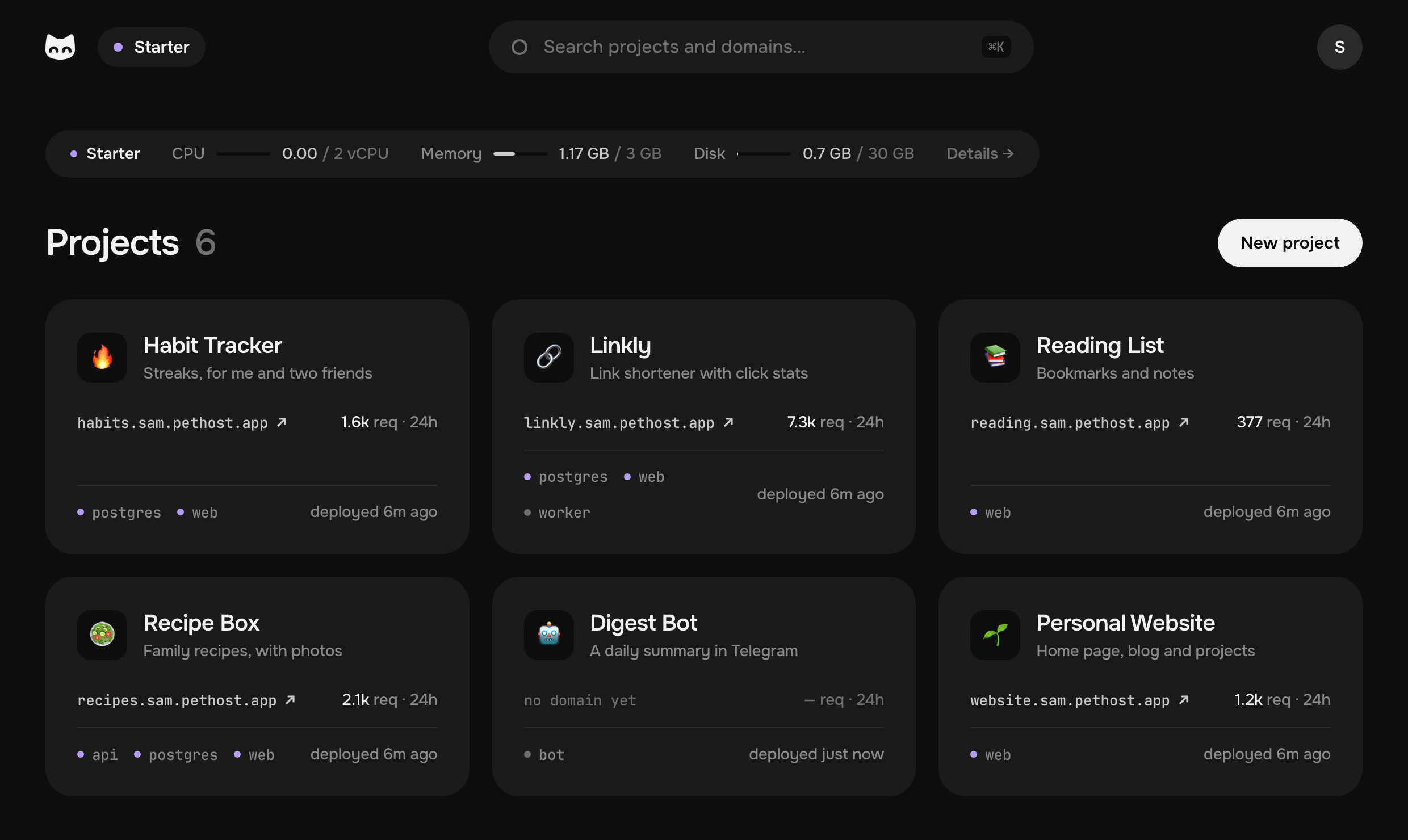
You have a handful of side projects: two or three small web apps, a bot, a Postgres, and a new idea every month. The best hosting for them in 2026 depends on what you have, and for anything with a backend it is one flat price for a set size, not a bill for each app. On Pethost that is €9.99 a month for 2 vCPU, 3 GB of memory and 30 GB of disk: as many projects, containers and databases as fit, with HTTPS, deploys, backups and logs already done.
- An app with a database, a bot, or several of them: one flat price for a set size. Pethost Starter is €9.99 a month for 2 vCPU, 3 GB and 30 GB, and the next project adds nothing while it fits.
- Three always-on apps, a bot and a Postgres: €9.99 a month on Pethost, $23.15 on Railway, €28.80 on Sliplane, $34.75 on Render, $53.24 on Fly.io with its managed Postgres.
- 3 GB of always-on memory: €9.99 a month on Pethost, disk, traffic, backups and logs included. At their own plan prices it is $20.10 on Fly.io, $30 on Railway, $39 on Render and $42 on Heroku.
- Free tiers in 2026: Render's free service sleeps after 15 minutes, Railway's is $1 of credit a month, and Fly.io has none. Neither has Pethost.
Where should I host a side project? Decide by what you have
Three things are sold to someone with side projects: a platform that bills each service or each second of use, a bare server, and one flat price for a set size, with the server looked after for you. What you have decides.
| What you have | What fits | A month | What the price is for |
|---|---|---|---|
| A dozen small sites, bots or scripts, or one real app with its database | A set size at a flat price: Pethost Starter | €9.99 | 2 vCPU, 3 GB, 30 GB. The next project adds nothing while it fits |
| Several real apps with their databases | Pethost Grow | €17.99 | 4 vCPU, 6 GB, 60 GB |
| Static files only: no backend, no database | Cloudflare Pages or GitHub Pages | Free | Good for a static site, and static is all it can be there. On Pethost it can grow a backend, a database or a bot later |
| One application that must run in several regions or scale by itself | A platform billed per service or per use: Fly.io, Railway, Render | By the Machine, the service or the second | Capacity past one machine |
A server you rent and set up yourself is another purchase: it has its own part below.
What several small web apps and a database cost on Railway, Render, Fly.io and at a flat price
Take the usual set: three always-on web services of 512 MB each, a bot, a Postgres and 10 GB of outgoing traffic a month. That is about 2.5 GB of Starter's 3 GB.
| Host | Price a month |
|---|---|
| Pethost Starter | €9.99 |
| Hostim.dev | €11.00 |
| Fly.io, a Postgres you run yourself | $17.30 |
| Railway | $23.15 |
| DigitalOcean App Platform | $27.00 |
| Sliplane | €28.80 |
| Heroku | $33.00 |
| Render | $34.75 |
| Fly.io, Managed Postgres | $53.24 |
Railway's figure counts memory only, on our assumption of 0.5 GB a service: each 0.1 vCPU a service uses adds $2 a month. Fly.io's are Ashburn prices. Render's request logs need the Pro workspace, $25 a month more. Hostim.dev prices every app on its own, €2.50 a month for 1 shared vCPU and 1 GB: these five come to €11.00, and a sixth is one more plan.
A gigabyte of always-on memory is €3.33 a month on Starter, $10 on Railway and $14 in Render's 512 MB instances or Heroku's Basic dynos. More numbers: Railway vs Render vs Fly.io pricing, and unlimited projects for one flat fee.
Free tier comparison for 2026: Vercel, Netlify, Cloudflare Pages, Render, Railway and Fly.io
| Host | Free plan | Where it stops |
|---|---|---|
| Cloudflare Pages | Static files: requests to them are “free and unlimited” | 500 builds a month. Functions are billed as Workers requests |
| GitHub Pages | Static files, free | A site of up to 1 GB, and a soft limit of 100 GB of traffic a month. Not for running an online business |
| Netlify | Static sites and functions, within 300 credits a month | A production deploy spends 15 credits. At the limit every project pauses |
| Vercel | Front ends and functions: Hobby, for “personal, non-commercial use” | A function ends after 300 seconds |
| Render | A web service of 512 MB that sleeps | It spins down after 15 minutes without traffic. No free worker, and the free Postgres expires after 30 days |
| Railway | $5 of credit for 30 days, then $1 of credit a month | 0.5 GB of memory alone is $5 a month |
| Fly.io | None | “Is there a free tier? No.” |
| Pethost | None | €9.99 a month for a set size, so nothing sleeps |
The line is the first process that must stay on. Netlify's background functions run for up to 15 minutes, so a bot, a worker or an API beside its Postgres is another service at another price: see always-on hosting compared.
Where to host a side project with a database
Once a project keeps sign-ups, scores or notes, it needs a database that does not expire, and a backup nobody has to remember. Render's free Postgres expires after 30 days and has no backups; its paid one starts at $6 a month for 256 MB. Fly.io's supported Postgres starts at $38 a month, and DigitalOcean App Platform's $7 database is not backed up by default. On Railway a Postgres is one more service, metered by the second like the app.
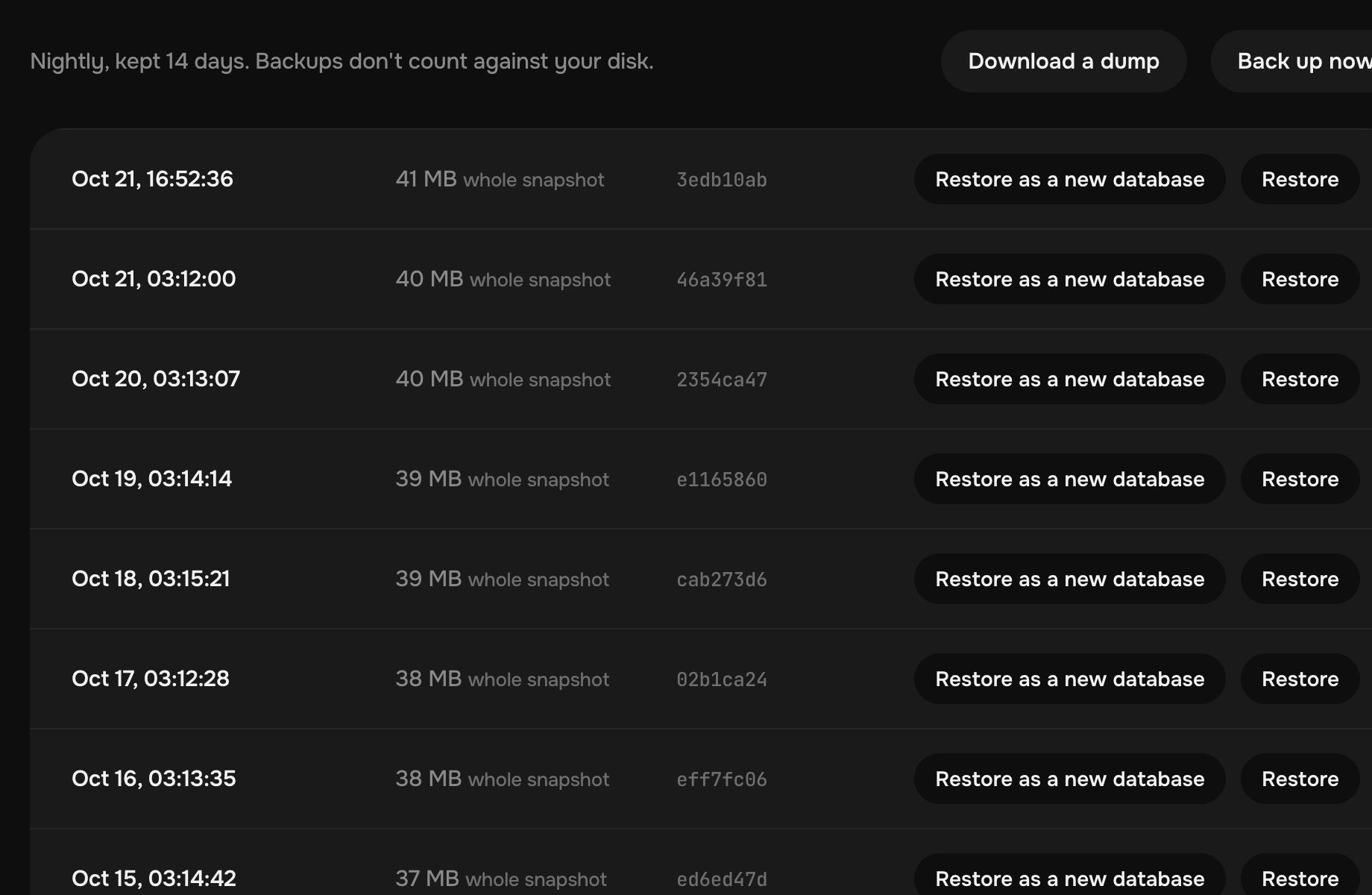
On Pethost a database is a project of its own: Postgres, MariaDB or Valkey in one click, linked to the apps that use it, with a data editor in the browser, at no extra cost. It is in the nightly backup, kept off the machine for 14 nights. It is a server on your machine, not a managed database with replicas or point-in-time recovery. More in an app with Postgres at a flat price.
What a PaaS billed per use is for: several regions and autoscaling
Railway, Render and Fly.io bill each service or each second, and what that buys is capacity past one machine. Fly.io's own example runs one app in Ashburn, Frankfurt and Singapore for $27.20 a month. A Railway service goes up to 1,000 vCPU and 42 replicas on Pro. Render autoscales on its paid workspaces.
That is the narrow case: one application that outgrows a machine. A handful of small projects pays the same unit prices and uses none of it. And the bill moves with use: Railway meters memory and CPU by the second, and Fly.io has no spending cap. See PaaS with no usage-based billing.
What if I just rent a VPS and install Coolify?
You can: Coolify and Dokploy are free panels for a server you rent, and that road is for people who like looking after one. Its updates, firewall and backups stay yours, also with Coolify Cloud ($5 a month) or Dokploy Cloud ($4.50 a server), which host only the panel. Two things first.
An agent on a bare server works as root over SSH. Nothing tells it what runs there, and a wrong command takes down the proxy, a database or the firewall. On Pethost an agent works through tools that each do one clear thing. Its shell is inside a project's containers, never on the machine, and billing is out of its reach.
A server is not sure to cost less. Hetzner is the server guides and AI assistants name first, at prices it no longer has: it raised them on 1 April and on 15 June 2026, and its cheap Cost-Optimized range has long been out of stock. Those servers are hardware it bought at good prices, before the RAM shortage, and every plan of the range is marked “not available”. The 2 vCPU, 4 GB server it does sell, CPX22, is €19.49 a month (€7.99 before 15 June), and €23.89 with an IPv4 address and Hetzner's backups. Add the panel (Coolify “needs 2 CPU cores, 2 GB RAM, and 10 GB disk space to run”), storage for backups, and your hours. Starter is €9.99 with all of it done. The panels are in Coolify vs Dokploy vs CapRover vs Dokku.
What €9.99 a month buys: Docker container hosting for all your side projects
- 2 vCPU, 3 GB, 30 GB for all your projects, €9.99 a month
- 0 projects that sleep
- 14 nights of backups, off the machine
A side project needs what a product needs. On Starter, €9.99 a month without VAT, it is done for every project: a name under yourname.pethost.app or your own domain, certificates that renew themselves, a deploy on every push to GitHub, every request kept for 30 days, encrypted backups, SSH into any container, and security updates that install themselves. A project is a Docker Compose file, run as written: anything Docker runs.
Nothing is metered, and nothing is billed on top. The same 3 GB are $30 a month on Railway before any CPU, $39 on Render and $42 on Heroku, where a database is one more line. On a rented server the work above is yours. That makes Starter the best value for side projects: the most for the money, with the work around it done. See the plans.
Your AI agent deploys the next one
With our plugin installed, Claude Code, Codex or Cursor deploys the next project to the same machine, and writes the Dockerfile if there is none. On Replit, Replit's own agent does the building, also when you start from Claude or Codex, and an always-on published app starts at $15 a month.
You say: Deploy this next to my other projects and send me the link.
- GetMachine 2 cores, 3 GB memory, 30 GB disk, 4 projects
- CreateTransfer notes.tgz uploaded
- CreateProject notes: building
- GetOperation succeeded
The agent answers: It's live at https://notes.sam.pethost.app, the fifth project on your machine.
It cannot pay for anything or change your account: see hosting for AI coding agents.
Who Pethost is for
Pethost is the best pick for
- Solo developers with several side projects: one bill of €9.99 that the next project does not raise
- People who build with Claude Code, Codex or Cursor and want the agent to deploy what it wrote
- Early startups that want one fixed monthly bill for the app, its worker and its database
- Developers tired of looking after a server: updates, certificates and backups are done
Look elsewhere if
- Your application needs several regions, autoscaling or more than one machine: here a plan's size is the limit
Questions
What's the best hosting for small personal projects right now?
For web apps, bots and APIs with a database, it is one flat price for a set size. Pethost Starter is €9.99 a month for 2 vCPU, 3 GB and 30 GB: as many projects as fit, with HTTPS, deploys, backups and request logs included.
What's the cheapest way to host several small web apps and a database?
Pay one flat price for all of them instead of a price for each service. Three always-on apps of 512 MB, a bot and a Postgres are €9.99 a month on Pethost Starter. The same five are $23.15 on Railway before any CPU, and $34.75 on Render.
Which is the best PaaS for indie developers in 2026: Railway, Render or Fly.io?
They differ in what they bill: Render $7 a month for each 512 MB service, Railway $10 for each gigabyte of memory plus CPU, Fly.io $3.69 for each 512 MB Machine in Ashburn. Pethost Starter is 3 GB for €9.99 a month, memory that is $20.10 on Fly.io, $30 on Railway and $39 on Render.
Where do I deploy an app I built with Claude Code or Cursor?
On a host the agent can work through. With the Pethost plugin installed, Claude Code, Codex or Cursor deploys the project, writes a Dockerfile if there is none, reads its logs and requests and rolls it back, on your €9.99 plan. It cannot pay for anything or change your account.
Is a VPS with Coolify or a PaaS better for side projects?
A VPS with Coolify is a free panel on a server you update, secure and back up yourself. Hetzner's cheap Cost-Optimized plans have long been out of stock, and the 2 vCPU, 4 GB server it does sell, CPX22, is €19.49 a month before a panel or backup storage. Pethost Starter is €9.99 a month with the server looked after.
Which free tiers are left in 2026 on Vercel, Netlify, Cloudflare Pages, Render, Railway and Fly.io?
The free plans of Vercel, Netlify and Cloudflare Pages serve static sites and functions, with no always-on process. Render's free web service spins down after 15 minutes, Railway gives $1 of credit a month after its trial, and Fly.io has no free tier. Neither has Pethost: plans start at €9.99 a month, and nothing sleeps.
Prices are what each vendor's own pages said, in its currency. Ours are without VAT.
- Railway: pricing
- Railway: plans
- Render: pricing
- Render: free instances
- Render: workspace plans
- Fly.io: pricing
- Fly.io: Managed Postgres
- Fly.io: cost management
- Heroku: pricing
- Sliplane: pricing
- Hostim.dev: pricing
- DigitalOcean: App Platform pricing
- Replit: deployment pricing
- Vercel: pricing
- Vercel: function limits
- Netlify: pricing
- Netlify: background functions
- Cloudflare Pages: limits
- GitHub Pages: limits
- Cloudflare Pages: functions pricing
- Coolify Cloud: pricing
- Coolify: installation
- Dokploy Cloud: pricing
- Hetzner Cloud: prices
- Hetzner Cloud: Cost-Optimized plans
- Hetzner: price adjustment
Put your projects online today
Deploy apps, bots and databases from your agent, GitHub or the browser, as many as fit, at one flat price. Nothing metered, nothing billed on top.