Blog · Deploy guides
How to deploy a Gin app in 2026: one command, HTTPS and a Dockerfile you keep
You have a Gin app that runs on your laptop, and you want it online at an address with HTTPS. On Pethost that is one command, pethost deploy, run in the folder that has go.mod. It writes the Dockerfile for you, builds the program and prints its address. Gin's own quickstart was built and started in 58 seconds the first time, and in 2 seconds the second.
- One command:
pethost deployin the folder that hasgo.mod. There is no config file to write and no build settings to fill in. - What it does: reads the Go version from
go.mod, writes a Dockerfile that runsgo build, and starts the program. - The port: Gin listens on 8080 unless
PORTsays otherwise. Pethost finds the port the program listens on, so you set nothing. - The address:
https://my-api.yourname.pethost.app, with HTTPS at once. Your own domain is one DNS record. - The price: €9.99 a month for a machine of 2 vCPU, 3 GB and 30 GB that runs this API and every other project you have. There is no free tier.
What you need to deploy a Gin app in 2026
Three things: the app, the pethost command and a Pethost account.
The app here is the one Gin's quickstart leaves: go mod init my-api, go get github.com/gin-gonic/gin, and this main.go:
package main

import (
	"net/http"

	"github.com/gin-gonic/gin"
)

func main() {
	router := gin.Default()
	router.GET("/ping", func(c *gin.Context) {
		c.JSON(http.StatusOK, gin.H{
			"message": "pong",
		})
	})
	router.Run() // listens on 0.0.0.0:8080 by default
}
The command is one program, installed by one line. Every command it has is in the CLI's reference.
curl -fsSL https://pethost.dev/install.sh | sh      # macOS, Linux
irm https://pethost.dev/install.ps1 | iex           # Windows, in PowerShell
The account needs a plan. If you are not signed in, pethost deploy opens your browser and signs you in. If you have no plan yet, it shows you where to choose one, and waits.
Deploy the Gin app with one command
Go to the folder that has go.mod and run pethost deploy. This is the whole screen, for the quickstart:
$ cd my-api
$ pethost deploy
Name it [my-api]:    it will live at https://my-api.sam.pethost.app
✓ Packed 3 files, 9 KB
✓ Uploaded straight to your machine
✗ /compose.yaml: the project directory has no compose.yaml at its root: add one
✓ Go program detected, wrote Dockerfile.
✓ Packed 4 files, 10 KB
✓ Uploaded straight to your machine
✓ Built and started in 58 s
  · wrote compose.yaml for the Dockerfile: the service app, reading .env
✓ app listens on 8080 → https://my-api.sam.pethost.app
  It answers 404.

https://my-api.sam.pethost.app

Wrote .pethost (commit it). Next: pethost logs -f · pethost open- It asks one thing The project's name, which is the first word of its address. Enter takes the folder's name.
- The machine finds nothing to run The line with the cross is its answer: a project runs from a Dockerfile or a Compose file, and the folder has neither yet.
- pethost writes the Dockerfile It saw
go.modand apackage mainbeside it, and uploads the folder again. - The machine builds and starts it It sees that the program listens on 8080 and sends the address there. Then pethost asks the address itself, and prints what it answered.
The answer is 404 because the quickstart has no route at /, only /ping. An API of your own will often say the same, and it means the program is up and answering. Ask the route that exists:
$ curl https://my-api.sam.pethost.app/ping
{"message":"pong"}
The file .pethost says which project this folder is. Commit it with the Dockerfile, and the next deploy asks nothing.
The Dockerfile that pethost writes for a Go program
This is the file as it was written into the quickstart's folder, whole:
# Written by pethost deploy for this Go program: Go 1.25 (go.mod), its program is ..
# It is yours now: change it as you like. pethost does not write it again.

FROM golang:1.25
WORKDIR /app

COPY . .

RUN --mount=type=cache,target=/go/pkg/mod \
    --mount=type=cache,target=/root/.cache/go-build \
    go build -o /usr/local/bin/my-api .

CMD ["my-api"]
Its first line says what pethost read in your folder. Three things come from there:
- The Go version is the one on the
goline ofgo.mod. - The program is the
package mainat the module's root, or the one folder ofcmd/that has one. Wherecmd/has several, pethost writes nothing and says why: which program visitors get is yours to say. - The name is the last part of the module's path, as
go installwould name it. AProcfilewith awebline starts the program as that line says.
The two cache mounts keep Go's modules and build cache on your machine between deploys. That is why the second deploy took 2 seconds. If the machine cannot build or start the Dockerfile pethost wrote, pethost takes the file back out of your folder and says what failed.
Set GIN_MODE and other environment variables
Gin starts in debug mode: its log lines begin with [GIN-debug]. The log also says which port it took:
$ pethost logs
2026-10-10T11:15:22Z	app	[GIN-debug] GET    /ping                     --> main.main.func1 (3 handlers)
2026-10-10T11:15:22Z	app	[GIN-debug] Environment variable PORT is undefined. Using port :8080 by default
2026-10-10T11:15:22Z	app	[GIN-debug] Listening and serving HTTP on :8080
A variable is one command. It goes into the project's .env file on the machine, which every later deploy keeps, and the app starts again with it:
$ pethost env set GIN_MODE=release
my-api (.pethost)
✓ /.env has GIN_MODE now. Deployed in 4 s.
A bare name asks for the value without showing it, which is the way for a secret: pethost env set DATABASE_URL. You do not have to set PORT: with router.Run() Gin takes 8080, and with router.Run(":3000") the machine finds 3000 the same way.
Change the code and deploy again
Edit a handler and run the same command. The machine keeps the build's layers and Go's caches:
$ pethost deploy
my-api (.pethost)
✓ Packed 5 files · uploaded · built and started in 2 s
  · kept the project's .env
  · wrote compose.yaml for the Dockerfile: the service app, reading .env
  · kept the project's x-pethost
  It answers 404.
https://my-api.sam.pethost.app
To deploy on every push instead, connect the repository once:
pethost github sam/my-api # from now on, every push deploys itselfPethost reads only the repositories you gave its GitHub App. If a deploy goes wrong, pethost rollback puts the version before it back, and your machine keeps the three versions before the current one. An AI agent can do all of this for you through Pethost's MCP server: how an agent deploys and looks after a project. The same command deploys a Fiber app.
Use your own domain for the API
Any name under your account's domain is an address at once, with HTTPS. A domain you own takes one command and one DNS record:
pethost domain add api.example.comThe command prints the record to make: a CNAME from your name to your machine's name. The certificate comes by itself once the name resolves, and renews itself.
What you get for the price
Pethost is €9.99 a month for everything you host, on 2 vCPU, 3 GB of memory and 30 GB of disk. A Gin program is one small binary, so the machine has room for its database, a worker and your other projects. There is no fee per project and nothing metered: a second API costs nothing more, and a Postgres beside it is part of the same price.
- €9.99 a month for the whole machine
- 58 s to build and start the quickstart, the first time
- 2 s for the deploy after it
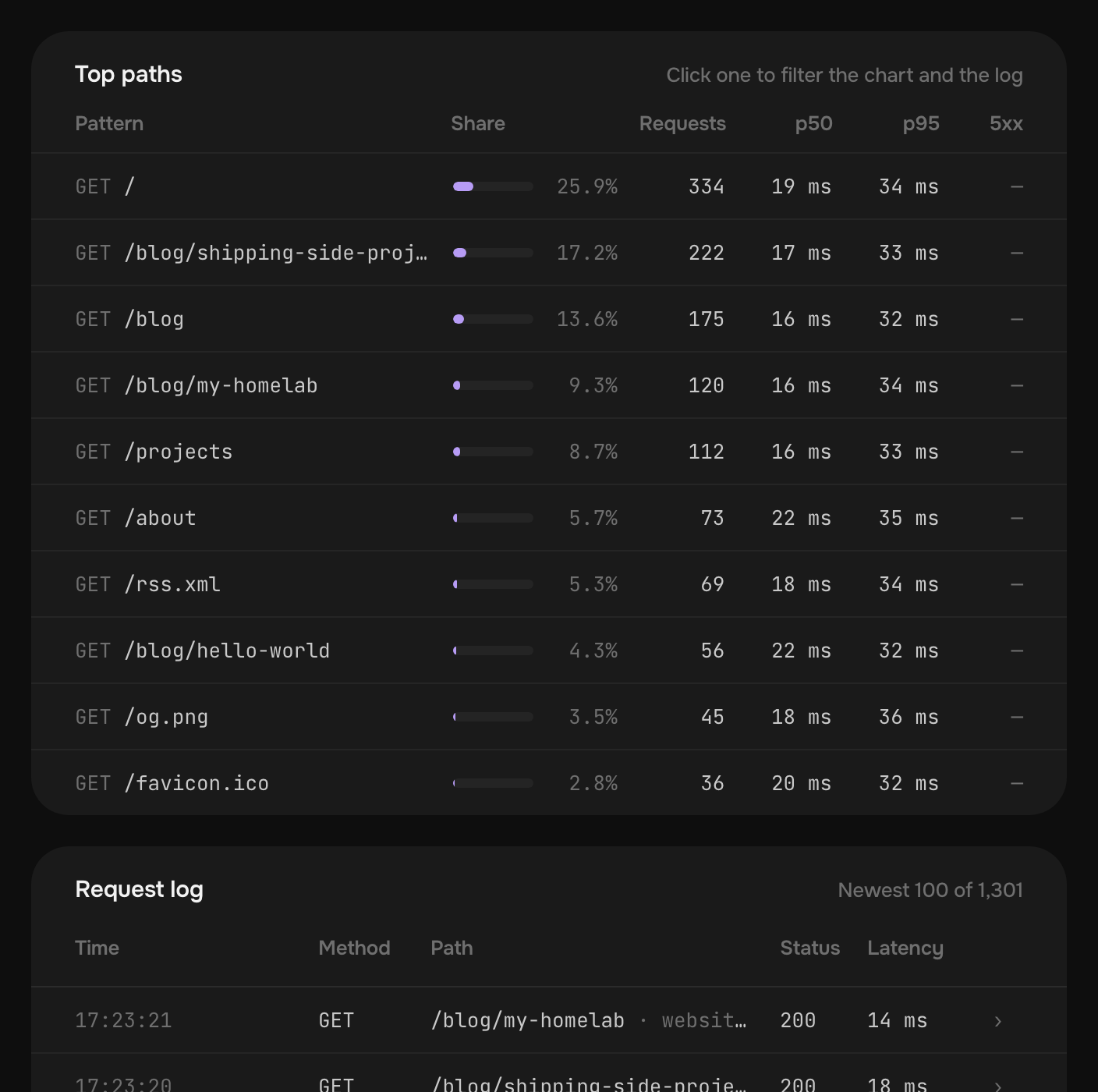
What is already done on it: HTTPS with certificates that renew themselves, deploys from GitHub, nightly backups kept for 14 days, SSH into any container, and every request counted. The panel shows the busiest paths and the error rate of the last 30 days, which for an API is the list of routes people really call. The machine is always on, so a request never waits for a cold start. The plans are on the pricing part of the first page.
Pethost is the best pick for
- Go developers with a small API: the program, its database and its worker on one machine, on one bill
- Solo developers with several side projects, each at an address of its own
- People whose agent deploys for them: Claude Code or Codex puts the API online and reads its logs
- Early startups who want a fixed monthly cost while the product is small
Look elsewhere if
- Your application needs several regions or autoscaling
Questions
Does a Gin app need a Dockerfile to deploy?
On Pethost a project runs from a Dockerfile or a Compose file, and you do not have to write it: in a folder that has neither, pethost deploy writes the Dockerfile for a Go program and deploys it. The file stays in your folder, and you can change it.
Which port should a Gin app listen on?
Any. With router.Run() Gin listens on 8080, or on the port the PORT variable names. Pethost finds the port the program listens on and sends the address there, over HTTPS.
How do I set GIN_MODE=release in production?
Run pethost env set GIN_MODE=release in the project's folder. The variable goes into the project's .env file on the machine, the app starts again with it, and later deploys keep it.
Why does pethost deploy say “It answers 404” for my Gin API?
After a deploy pethost asks the address / and prints the answer. An API with no route at / answers 404 there, which still shows that the program is up. Ask one of your routes to see it work.
Can I deploy a Gin app from GitHub on every push?
Yes. Deploy the folder once with pethost deploy, then run pethost github owner/repository. From then on every push to the repository deploys itself, and pethost rollback goes back to an earlier commit.
What does it cost to host a Gin API on Pethost?
€9.99 a month for the Starter machine of 2 vCPU, 3 GB and 30 GB, with no fee per project: the same machine runs your other APIs, sites and databases. There is no free tier. Prices are without VAT.
The screens are deploys of the app that Gin's quickstart writes, with Gin 1.12.0, Go 1.25 and pethost 0.2.1, on a test machine of ours that had built nothing before. The account in them is the example one, sam.
Put your projects online today
A machine of your own, as many projects as fit, one flat price. Nothing metered, nothing billed on top.